
Posted by:
Post Date:
2026.08.27
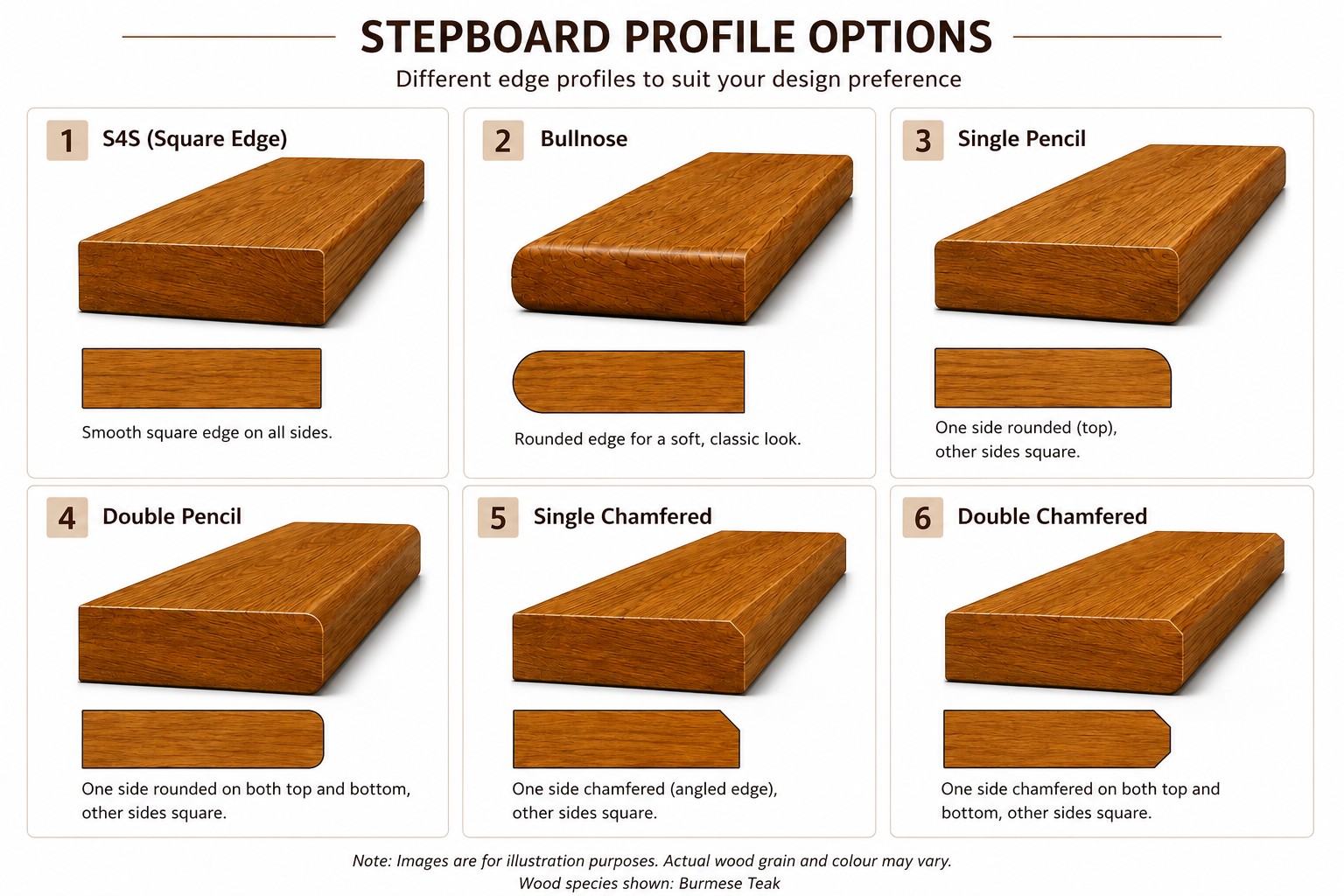 Most homeowners focus on timber color and stepboard thickness when customizing their wooden stairs, often overlooking the front edge profile altogether. Known as the stair nosing, this is the leading corner of the stepboard that meets your foot as you climb. It is an easily missed detail, but choosing the right edge contour—whether softly curved or cleanly squared—adds that extra touch of refinement and comfort to your daily living space.
Because solid hardwood stepboards are milled from thick, genuine timber—typically 30mm, 35mm, or 45mm—the leading edge can be custom-profiled to suit your specific interior design language. Choosing between a traditional round bullnose, an angular chamfer, or a sleek modern pencil round comes down to balancing tactile comfort, safety, and visual minimalism.
The Classic Full Bullnose: Maximum Softness and Traditional Warmth
The full bullnose profile features a completely rounded, semi-circular edge that wraps smoothly from the top surface of the stepboard down to the underside.
This profile has long been the classic choice for traditional and colonial landed estates. The uninterrupted arc of a full bullnose creates a soft, forgiving contact point underfoot. For households with young toddlers learning to navigate stairs or elderly family members, the rounded contour minimizes the risk of painful bruises if someone trips or knocks their shins against the step.
From an aesthetic standpoint, the full bullnose emphasizes the physical thickness of the timber, making individual stepboards look substantial and inviting. However, because the profile is distinctly curved and rounded, it leans toward a classic or transitional look, which can feel overly soft in sharp, ultra-modern minimalist homes.
The Modern Pencil Round: Crisp Lines with Understated Safety
The pencil round, often referred to as an eased edge or micro-round—has become the undisputed favorite among modern architects and interior designers. This profile maintains a crisp, predominantly flat vertical face, with only the top and bottom corners delicately radiused to the curvature of a standard pencil edge (typically a 3mm to 5mm radius).
The pencil round delivers the best of both worlds. From across the room, the staircase appears clean, sharp, and geometric, perfectly complementing contemporary features like frameless glass balustrades, recessed wall handrails, and floating steel stringers. At the same time, the slight softening of the top corner removes the sharpness that could otherwise chip, splinter, or catch on socks.
Walking down a pencil-round staircase feels secure, offering a defined edge that gives the ball of your foot clear tactile feedback without biting into the arch of your foot. It is the natural choice for Japandi, modern luxury, and minimalist urban residences.
The Chamfered Edge: Geometric Precision and Light Play
The chamfered profile takes a distinct architectural approach by shaving the leading top corner at a precise 45-degree flat bevel, usually measuring between 3mm and 6mm.
Rather than blending the edge into a curve, the chamfer creates a crisp, angled facet that catches descending light differently than the top flat plane of the tread. This facet creates a sharp highlight line along the edge of every step, visually separating the steps and enhancing depth perception when walking down the staircase in dim evening lighting.
A chamfered nosing pairs exceptionally well with industrial interiors, modern Scandinavian homes, and spaces featuring slatted acoustic wall panels or fluted timber joinery.
Balancing Practical Living with Architectural Vision
Selecting the right nosing profile shapes how your staircase interacts with your daily routine and the surrounding architectural elements.
If family safety and maximum impact softness are your primary goals—especially in busy multi-generational homes, the gentle curves of a full bullnose provide timeless reassurance and classic warmth.
If you are crafting an angular, design-forward interior with structured lines and bold lighting contrasts, a chamfered edge brings subtle architectural drama to every step.
If your vision centers on clean, sophisticated contemporary design that looks sharp from the ground-floor living area while remaining comfortable and safe for daily barefoot living, the modern pencil round remains the gold standard in contemporary timber craft.
Back